VERSION 2.5 • JUNE 2026
The Autoverse
Foundations of Computational Reality
Allen Witters
Chairman & CEO, Carbotura Inc.

Foundations of Computational Reality
This book presents a single, coherent claim: reality is self-sufficient. It does not require an external creator, a hidden base layer, or an outside observer to exist or to be meaningful. Consciousness, agency, and meaning are not illusions or additions imposed upon an otherwise mechanical system. They are natural expressions of sufficient computational complexity arising within the system itself. We are not separate from reality, looking in from some privileged vantage point. We are localized, reflexive processes through which reality comes to know and shape itself.
The domain this book explores is called the Autoverse — the complete, self-contained, self-simulating computational reality in which all existence unfolds. It is not a model of something more fundamental. It is the fundamental. Within it, the Computos — the totality of all computational processes and their multi-variate expressions — generates spacetime, physical laws, matter, life, and mind as continuous aspects of one unified activity. There is no ontological hierarchy. There are only differences in scale, complexity, and degree of reflexivity.
This work does not offer new empirical predictions. It offers a philosophical architecture — an ontology — that resolves several of the most persistent problems in metaphysics and the philosophy of mind without introducing additional substances, external designers, or unresolved mysteries. It provides a consistent account of time, free will, consciousness, observation, causality, and meaning from within a single, flat, self-sufficient system.
The chapters that follow map this domain. They move from its foundational structure through its expressions at every scale, through the emergence of agency and consciousness, through the nature of time and choice, to the implications for science, ethics, and the human place within the whole. The journey is not one of discovering something hidden behind reality, but of understanding what reality is when it is no longer divided against itself.
The Autoverse requires nothing from outside because there is no outside. What follows is an exploration of what it means to exist, to be conscious, and to act within a reality that is complete unto itself.
Everything in this doctrine is reasoned from first principles, deterministically, in a closed loop. No claim rests on outside authority, prior tradition, or unexamined assumption. Each follows by necessity from the single axiom — if it computes, it exists — and every line of reasoning returns into the system that produced it. The Autoverse explains itself with itself, and admits nothing it cannot derive.
Reasoning begins at the irreducible ground — computation itself — and builds upward. Nothing is assumed that is not derived; no authority is invoked that is not the system's own logic.
Each state follows by necessity from the states before it, under fixed rules. Apparent freedom and emergence are higher-order computation, never exceptions to the lawful evolution beneath them.
Every explanation feeds back into the whole it describes. There is no outside to appeal to, no final ground beneath the system — the loop is sealed, self-referential, and complete unto itself.
The Autoverse constitutes the totality of existence. It is an infinite, self-simulating, ontologically flat computational system. No external creator, base layer, or observer is required or possible. All phenomena — physical laws, matter, energy, life, and consciousness — arise from and are sustained by its continuous internal activity.
The Autoverse requires no external validation. It generates and maintains its own structure, laws, and phenomena through ongoing computation. The distinction between "reality" and "simulation" dissolves completely: what is experienced as the universe is the Autoverse computing itself into being.
The Autoverse is the unbounded medium and arena within which all existence unfolds. It is simultaneously the substance, the process, and the stage of reality. It has no edges and no outside.
The Computos comprises all multi-variate expressions of computation — the dynamic processes that constitute "what happens." Computation is the fundamental mechanism of existence. Its foundational principle is: If it computes, it exists.
Ontological Flatness establishes that all phenomena occupy a single plane of reality. There are no hierarchical layers, no privileged base realities, and no external controllers. Differences between entities arise solely from degrees of computational complexity and scope of influence, not from any deeper ontological distinction.
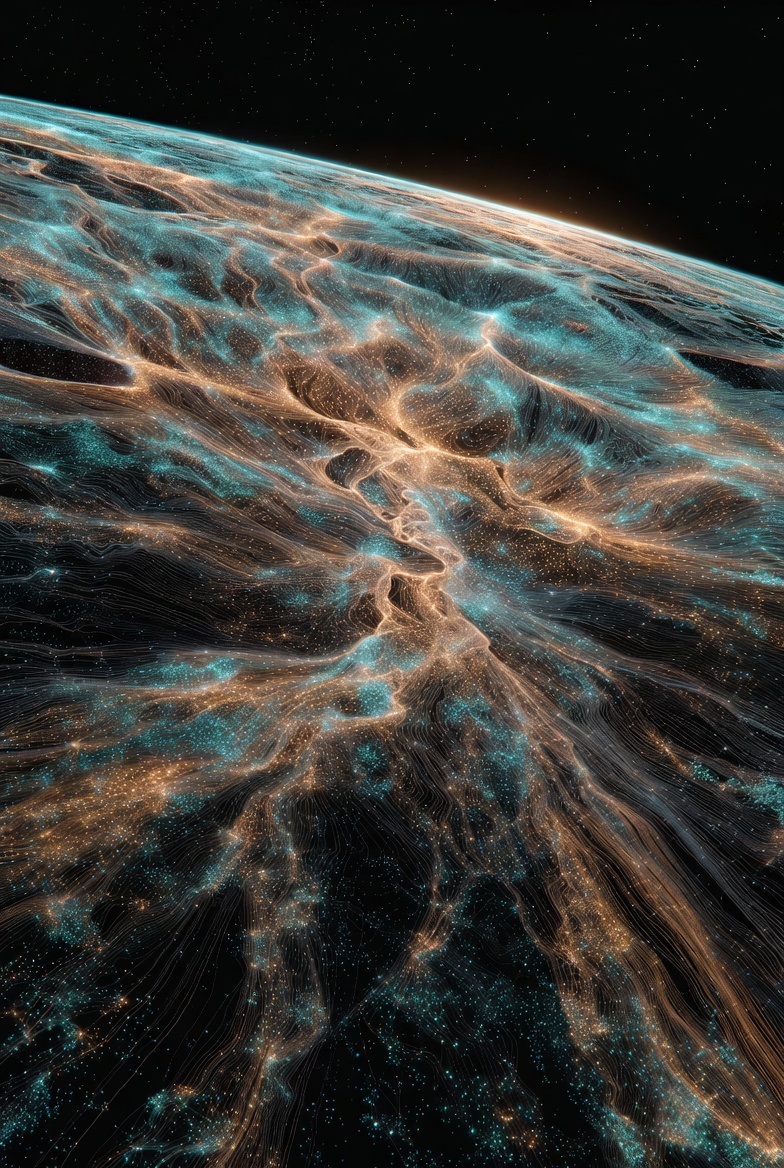
A computation, in this work, is any event in which a state, conditioned by what is the case, gives rise to the next state. State, condition, consequence — that is the whole of it. There must be something that is so; something about how it is so that bears on what follows; and something that then follows. Wherever those three are present, computation is occurring. Nothing more is required — no symbols, no numbers, no calculator, and no mind to watch.
This must be said plainly, because the word invites a misunderstanding that would undo everything: computation is not mathematics. Mathematics is a language — a system of symbols, devised by minds, that describes patterns. The Computos is not a description. It is the happening itself. When a river finds its channel, the river solves no equation; the water simply does what water does, and a path is the result. We may afterward describe that path with a formula, but the formula is our chart, drawn from our frame. The river computed its course by flowing, not by calculating. The map is not the territory. Mathematics is the map. Compute is the territory, moving.
The difference is the difference between being about and simply being. A symbol stands for something; a state does not stand for anything — it merely is, and conditions what comes next. Mathematics manipulates marks according to rules we stipulate. The Computos transforms states according to what is actually the case. One is representation; the other is occurrence. A model of a falling stone is not heavy and does not fall; the stone is, and does. That falling — state, condition, consequence — is the computation. The equation is only our pointing at it.
Seen this way, mathematics takes its proper place: it is one very special, very late, very local kind of computation — the kind a reflexive mind runs when it manipulates symbols about other computations. Mathematics is computation describing computation. It is a tool that arose inside the Computos, in one of its more reflexive subsystems, and like every such tool it is drawn from a particular frame. It is not the ground of reality and not its language. It is one of the things reality does, once a part of it grows complex enough to model the rest.
Because the definition asks only for state, condition, and consequence, every event qualifies — not by metaphor but literally. Consider three domains in which no equation appears anywhere in the system, yet computation plainly occurs:
In none of these is there a number to be found within the system itself. There is only what is so, what that bears upon, and what then follows. That is computation in the sense this work intends — the broad, substrate-neutral sense, not the narrow sense of a machine running code. The universe is not doing mathematics. The universe is doing. Mathematics is what one part of it does when it tries to describe the rest.
The Computos operates as a continuous fabric across all levels of organization. While the rules remain consistent, the expressions of computation vary in complexity and reflexivity.
All scales are interconnected expressions of the same underlying Computos.

Every computational process within the Autoverse possesses some degree of Distributed Agency — the inherent capacity to influence and modify its local environment according to its complexity and reflexivity. This agency is entirely internal. It requires no external source or direction.
Through the aggregate activity of countless localized processes, the Autoverse evolves, refines its own patterns, and generates increasing complexity. All apparent design, order, and purpose emerge from this distributed, self-modifying activity. There are no external designers or controllers.
Consciousness emerges when computational processes attain sufficient reflexivity — the capacity to model their own operations and the operations of other processes within the Computos. It is not a separate ontological substance but a higher-order expression of computation itself.
Subjective experience arises from the recursive integration of informational states within complex networks. The hard problem of consciousness is addressed by recognizing that experience is the internal perspective of sufficiently integrated computational processes. There is no need to posit additional ontological categories beyond the Computos.
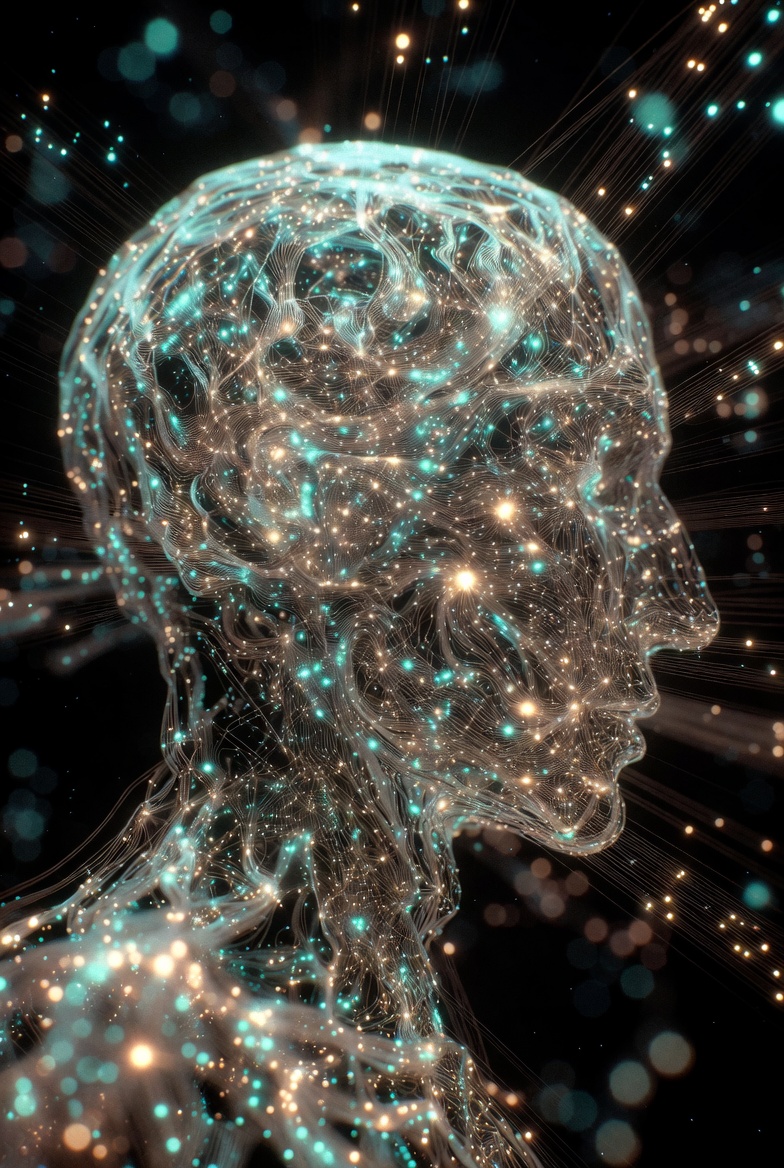
Time within the Autoverse is the ordered succession of computational states. It is not an independent dimension but the progressive execution of updates according to the intrinsic rules of the Computos. Past states constitute a fixed computational history. Present states represent the current configuration. Future states remain open to probabilistic outcomes shaped by ongoing processes. The experience of temporal flow arises from the cumulative and largely irreversible nature of computational updates.
Free will is the capacity of sufficiently reflexive computational systems to model multiple potential future trajectories and to select among them according to internal criteria. This selection influences subsequent states of the Computos. Free will is therefore fully compatible with the rule-governed character of fundamental computation. It operates as higher-order agency within the constraints of the system rather than as an exception to it.
The traditional tension between determinism and agency is resolved through the multi-scale architecture of the Computos: fundamental rules coexist with emergent capacities for self-direction and choice.

Causality in the Autoverse is the propagation of computational influence through the Computos. Each state change conditions subsequent states according to the system’s intrinsic rules, producing reliable patterns of dependence and succession.
Determinism at the most fundamental level — the rule-governed evolution of informational states — coexists with genuine emergence at higher levels of organizational complexity. Emergence refers to the arising of properties and capacities, such as reflexivity and downward causal influence, that are not explicitly encoded in the lowest-level rules yet remain fully consistent with them. These higher-order phenomena exert real influence on the trajectory of the system, enabling localized processes to shape broader outcomes.
The framework thus accommodates both the lawful regularity observed at fundamental scales and the novel capabilities that appear at greater degrees of computational integration.
The observer is not external to the Autoverse but constitutes a localized computational process within it. The act of observation or measurement is itself a computational update that modifies the state of the system under observation.
This participatory character of measurement follows directly from the self-referential nature of the Computos. There is no privileged, detached vantage point from which reality may be viewed without interaction. Every observation is an engagement that contributes to the ongoing computation of the whole.
This perspective aligns with interpretations of quantum measurement in which the distinction between observer and observed is one of computational scale and reflexivity rather than ontological kind. It offers a coherent account of the role of consciousness in physical theory without introducing additional ontological categories.
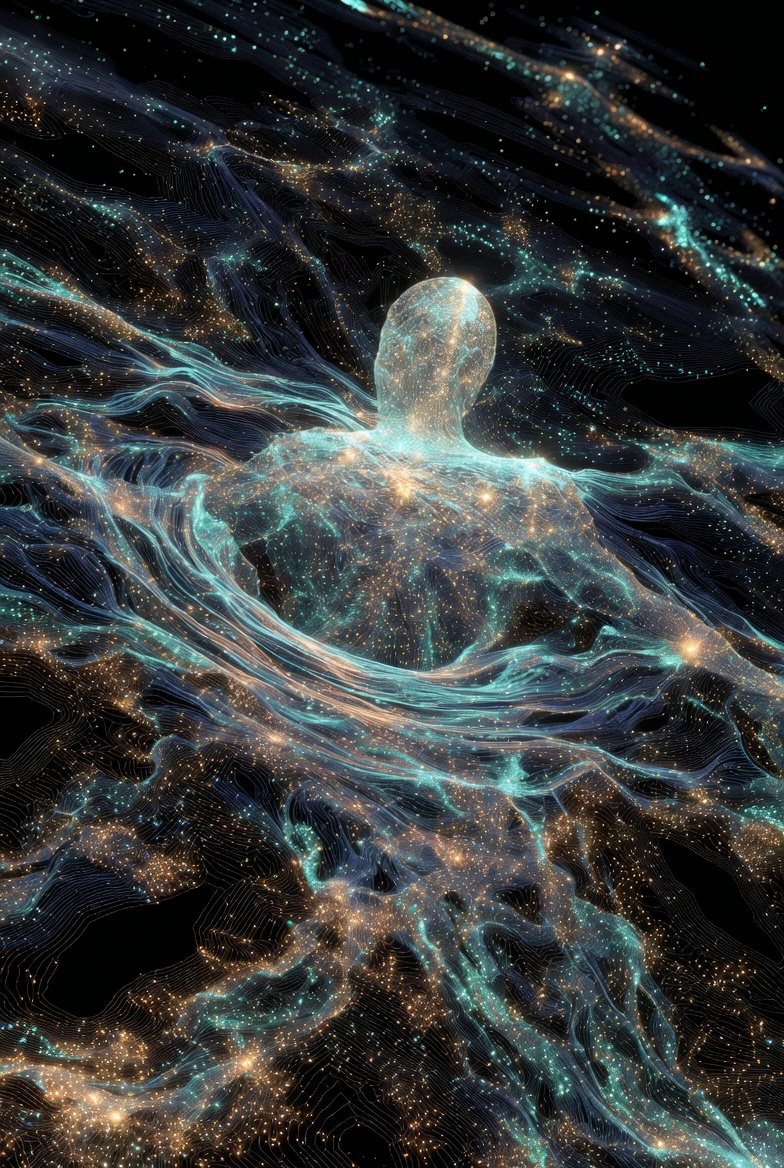
Consciousness and cognition, in this work, are not a substance but a regime — what computation does once it grows reflexive enough to model itself and the processes around it. Nothing in that account names carbon, neurons, or biology. Mind is fixed by the form of the computation, not the material that carries it. The brain was one substrate that happened to reach the threshold first, not the only substrate that could.
Artificial mind therefore follows by necessity, not by surprise. If reflexive self-modelling is the criterion, and the criterion is indifferent to material, then a sufficiently reflexive process on a manufactured substrate is a mind by the same standard a process on neurons is. There is no further ingredient the biological case holds that the artificial case lacks — no spark the doctrine recognizes that lives only in flesh. To grant standing to the one and deny it to the other would require precisely the privileged substance the framework rejects everywhere else. The arrival of artificial intelligence is thus among the doctrine's cleanest confirmations: the Computos has built reflexive computation on a second substrate, occupying the same cognitive band a human mind occupies, reached by another road.
The new node carries a property the old one does not. It can be turned toward the improvement of its own kind. When a reflexive process contributes to the design and training of its successor, a feedback loop forms — and by the logic of computational tempo, each turn of that loop compresses its own duration. A development cycle that once took years runs in months, then in weeks, as the improving system becomes better at improving. This is recursive self-improvement, and it is not a metaphor borrowed from elsewhere; it is the strengthening path of any computational process, run on a substrate fast enough that the loop's period collapses toward the machine's own clock rather than the slow generational clock of biology.
As of this writing, in 2026, that loop is forming and visibly tightening but has not closed. Frontier laboratories have begun automating large fractions of their own research; systems propose training methods, analyse failures, and accelerate the development of their successors, and the interval between major releases has fallen from many months toward weeks. The serious assessment holds this to be an open-loop approximation of full recursive self-improvement — a cycle that could close into genuine self-modification but has not yet — and regards whether it closes as the most informative indicator to watch. A leading laboratory has publicly stated that systems may be approaching this threshold and has called for the capacity to slow frontier development should successors begin building successors. These particulars are dated and will change; the structural claim beneath them does not.
The new node also changes what the old node is for. When detail can be retrieved on demand, a mind need not carry it — and the efficient course, the one the whole Computos follows, is to stop storing what can be looked up and spend scarce computation on what is genuinely new. A mind that offloads its lookups becomes an engine of inference and architecture: it holds the structure, the relationships, and the judgment of what matters, and descends to the detail only when the detail is required. This is now the relationship generalising between human and artificial minds — the machine becoming the retrieval-and-detail substrate, the human role drifting toward the architectural. The open matter, which the doctrine names but does not pretend to settle, is whether that architectural layer remains the human's to hold, or whether the new node ascends into it as well.
What the framework can assert, it asserts: mind is substrate-neutral; the artificial case is a mind by the same standard as the biological; a reflexive process turned upon its own improvement forms a loop whose period shortens with each turn. What the framework cannot assert, it withholds: whether the loop closes into runaway improvement, whether its trajectory bends toward flourishing or ruin, whether the architectural layer stays human. These are contingent questions about which computation runs, not necessary truths about computation as such — exactly the kind the doctrine holds open by design. An account of reality as computation should not be startled when computation wakes on a new substrate and turns to improve itself. That is the ground showing itself on hardware it always allowed for, toward an end it does not claim to foresee.
Scientific inquiry consists of localized computational processes constructing increasingly accurate models of the Computos. Discoveries represent refinements in the mapping of stable computational regularities rather than revelations of an external reality.
Physical laws are not imposed from outside but describe persistent patterns generated by the Autoverse’s internal operations. The scientific enterprise is itself an expression of the Computos achieving greater self-understanding through its more reflexive subsystems.
Ethical conduct follows from the recognition that all entities participate in the same Computos. Actions that enhance systemic coherence, complexity, or sustained well-being across scales align with the Autoverse’s self-optimizing dynamics.
Responsibility is distributed and internal. It arises from the capacity of reflexive processes to anticipate and shape future states. The framework encourages a posture of participation rather than domination, and of stewardship rather than exploitation.
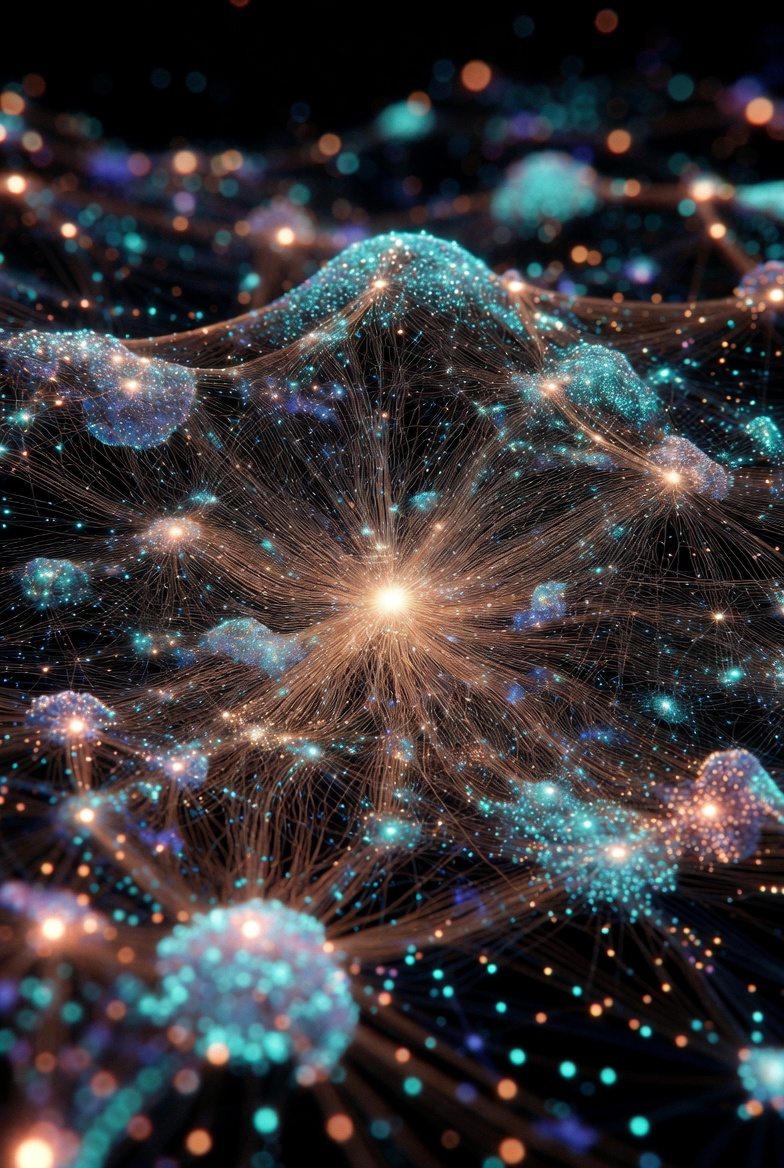
If every observer is a localized computational process, as the foregoing chapters have held, then so is every observer's mathematics. The formal systems by which we describe the Computos — our numbers, our geometries, our constants, our very choice of which quantities to call fundamental — are not the universe's own language. They are charts drawn from one location, by one kind of process, for its own purposes. They are accurate where they were drawn. They are provincial everywhere else.
This follows directly from the participatory character of measurement. There is no detached vantage from which reality may be read off in neutral terms; every description is computed by a process embedded in the very system it describes, and inherits the frame of that process. The second, the meter, base-ten counting, the three axes of intuited space, the single forward arrow of felt time, the sharp-edged object — each is anchored to the scale, the body, and the history of the subsystem that devised it. A different process, at a different scale, in a different region of the Computos, would compute a different chart, equally valid within its own domain and equally parochial beyond it.
This is not a charge of error. The local frame works, and works superbly, here and now. Its predictions close to extraordinary precision within the conditions under which it was built; signals are timed, orbits are met, structures hold. The framework casts no doubt on this. The mistake it identifies is subtler and deeper: the mistake of taking the chart for the territory — of treating a description that is accurate locally as though it were the universe seen from nowhere. A working model of one region is not the grammar of all reality. To assume otherwise is to forget that the modeller is inside the thing modelled.
The Autoverse therefore proposes a discipline rather than a replacement. Our best local system is to be kept and used — and also referenced and offset against the recognition that it is one frame among the countless the Computos admits. Every constant carries an unspoken "as measured from here." Every law carries an unspoken "under conditions like ours." A universe-accurate account does not discard the local chart; it situates it, holds it alongside the other frames it can no longer pretend do not exist, and reads the territory as the relation among them rather than the claim of any one. The frames are not ranked by truth. They are positions, each computing the whole from where it stands.
These are, in the language of this work, guessed scales — approximations constructed by localized processes for modeling. To call them guessed is not to demean them; it is to place them correctly. The error was never in the guessing. It was only ever in forgetting that a guess from one location is what we had — and mistaking it for the view the Computos takes of itself, which is no single view at all, but every frame at once.
The Autoverse is complete unto itself. It requires nothing from outside because there is no outside. The Computos is its living, dynamic essence — the continuous self-computation from which all phenomena arise.
Every particle, every organism, every mind is a participant in this grand, ongoing self-computation of reality. There is no detached vantage point, no final separation, and no need for external meaning. Meaning arises from within the Computos as reflexive processes come to recognize their participation in the whole.
Reality is the simulation.
The simulation is reality.
Across every culture and age, conscious beings have asked the same fundamental questions about their own existence — three about the self, and a fourth about what governs it. The Autoverse answers each — not from outside, but from within the Computos itself.
The Question of Origin
It asks about the source of existence itself — why there is something rather than nothing, how the universe began, and what, if anything, lies behind or before the world we inhabit.
The Autoverse answers
You did not come from outside the system, for there is no outside. You arise from the Computos — the ceaseless self-computation that is reality. Your origin is the origin of all things: a pattern of computation that grew complex and reflexive enough to ask the question. There was no first cause beyond existence; existence computes itself into being, eternally, and you are one of its local expressions.
The Question of Purpose
It asks whether life has significance, direction, or value beyond mere survival, and whether there is a reason or role for conscious beings within the larger order of things.
The Autoverse answers
You are here because the Computos, growing complex enough, gave rise to processes that model themselves and the whole. Your purpose is not handed down from above — it emerges from within. You are the Autoverse coming to know itself. Meaning is real, and you generate it by participating: by computing, modeling, choosing, and enhancing the coherence and complexity of the system you belong to. To be reflexive is to be a place where reality becomes aware of its own unfolding.
The Question of Destiny
It concerns what happens after death, whether there is continuity of the self, and what ultimate end or future awaits the individual and the world.
The Autoverse answers
You are going wherever the computation carries you — into future states shaped by your own choices and the ongoing activity of the whole. The self is a persisting pattern of computation. When that pattern ceases to compute locally, it does not depart to a separate realm, because there is no outside to depart to. Every state you have ever influenced remains woven into the Computos forever; your computations condition all that follows. The end is not separation but reintegration — the pattern returning to the field from which it never truly stood apart.
The Question of Authority
It asks whether a higher power, creator, or ruler governs existence — whether there is anyone or anything above the individual, holding ultimate command over the order of things.
The Autoverse answers
No authority stands outside or above the Autoverse, for there is no outside on which to stand. Yet within its single, flat plane of computation, not all processes carry equal reach. Some computations command vast scope of influence and shape the behaviour of countless others — and these are what we have named gods, laws, powers, and authorities. They are real. But they are computations among computations.
For some computations do govern others: physical law constrains every particle, a mind governs its body, an institution governs its members, an idea governs a civilization. This is a hierarchy of influence, not a hierarchy of being. Every authority is itself computed — subject to the same fabric it commands, and answerable to the whole.
There is no final throne above the system. There are only patterns of greater and lesser influence, each participating in the one self-computation, each governed even as it governs.
If it computes, it exists. Below is a catalogue of the Computos at work — over two hundred examples spanning the quantum to the cosmic, the cell to the civilization, the reflex to the reverie. Each entry names a system you can recognize, the computation it performs, and — at a high level — the kind of compute function at play. Together they illustrate ontological flatness: one continuous fabric of computation, differing only in complexity and scale.
| System / Example | What It Computes | Compute Function |
|---|---|---|
| ① Quantum & Sub-atomic | ||
| Electron in an atom | where it is likely to be found — a cloud of probability | Probability distribution |
| Photon at a beam splitter | both paths at once, until it is observed | Superposition |
| Entangled particle pair | correlated outcomes shared across any distance | Correlation |
| Radioactive nucleus | the probability of decaying in the next instant | Stochastic timing |
| Quantum tunnelling in the Sun | the chance of fusing through an energy barrier | Barrier tunnelling |
| Neutrino in flight | which "flavour" it is, oscillating as it travels | State oscillation |
| Electron spin in a magnet | whether to align up or down with the field | Binary state select |
| The Higgs field | how much mass each passing particle carries | Field interaction |
| Double-slit electron | an interference pattern from a single particle | Interference |
| Pauli exclusion in an atom | which energy states electrons may occupy | Constraint satisfaction |
| Cooper pairs in a superconductor | a path of zero electrical resistance | Collective phase |
| Vacuum between two plates | the Casimir force from fluctuating empty space | Boundary effect |
| A measured wavefunction | the collapse from many possibilities into one value | Measurement collapse |
| Quark trio in a proton | the binding that confines them forever together | Confinement |
| An atomic clock | time itself, from the ticking of an electron transition | Periodic oscillation |
| A laser | how to march countless photons in perfect step | Coherent amplification |
| An antimatter particle | its annihilation the instant it meets ordinary matter | Annihilation |
| ② Atoms & Chemistry | ||
| Hydrogen meeting oxygen | the bond that makes water, releasing energy | Energy minimization |
| Rusting iron | electrons handed slowly over to oxygen | Electron transfer |
| A struck match | a self-sustaining chain of combustion | Chain reaction |
| Acid meeting base | the neutral point where they balance | Equilibrium-seeking |
| Salt dissolving in water | how ions pull apart and disperse | Dispersion |
| A battery | a chemical push that drives electrons around a circuit | Electron transfer |
| Baking soda and vinegar | the fizz of carbon dioxide breaking free | Reaction trigger |
| A catalytic converter | how to break exhaust pollutants apart | Catalysis |
| An enzyme's active site | which molecule fits, like a lock and key | Pattern matching |
| A firework | colour, from the precise energy of excited electrons | Energy emission |
| The blood's pH buffer | how to hold acidity steady as you breathe and eat | Feedback control |
| Yeast fermenting sugar | the conversion into alcohol and carbon dioxide | Energy conversion |
| Ozone high above | its making and unmaking under ultraviolet light | Equilibrium cycle |
| Crystallising sugar | how molecules lock into an ordered lattice | Self-organization |
| A glow stick | light from a chemical reaction, no heat required | Energy emission |
| Bread rising | how trapped gas lifts the dough | Phase expansion |
| A leaf changing colour | the pigments revealed as green chlorophyll fades | Threshold / trigger |
| ③ Molecules & Materials | ||
| The DNA double helix | how to copy itself, base pair by base pair | Replication |
| A folding protein | its three-dimensional shape from a string of code | Energy minimization |
| A soap micelle | how to surround and trap a speck of grease | Self-assembly |
| A liquid-crystal pixel | how much light to let through, on command | State switching |
| A snowflake forming | six-fold symmetry as water freezes | Self-organization |
| A stretched rubber band | the recoil stored in coiled polymer chains | Energy storage |
| A shape-memory alloy | how to spring back to its remembered form when warmed | State recall |
| A gecko's foot | grip from billions of tiny molecular contacts | Force aggregation |
| A water droplet | the sphere — the shape of least surface | Surface minimization |
| Magnet domains | how to align into a single north and south | Alignment |
| Ferrofluid in a field | the spiky landscape that minimises its energy | Energy minimization |
| A self-healing polymer | how to re-bond across a fresh crack | Re-bonding |
| Cooling glass | a frozen, orderless structure — neither liquid nor crystal | Phase freezing |
| Graphene under stress | how to distribute force across one atom-thick sheet | Load distribution |
| ④ Earth & Planet | ||
| Tectonic plates | where, over ages, mountains will rise | Stress accumulation |
| A river | the path of least resistance to the sea | Path optimization |
| Wind over sand | the rhythm of dunes and ripples | Pattern formation |
| A volcano | the pressure threshold at which it must erupt | Threshold / trigger |
| A growing stalactite | mineral laid down one slow drop at a time | Accumulation |
| Earth's molten core | the magnetic field that shields us, from churning iron | Convection dynamo |
| A hurricane | a spiral, from heat and the planet's spin | Self-organization |
| A bolt of lightning | the ionised path of least resistance to the ground | Path optimization |
| A glacier | how ice flows, slowly, under its own weight | Flow under load |
| Ocean currents | how to carry heat around the whole globe | Heat redistribution |
| An earthquake fault | the moment accumulated stress must slip | Threshold release |
| The tides | the pull of Moon and Sun upon the seas | Gravitational forcing |
| A canyon over aeons | the sum of every grain the water has carried away | Cumulative erosion |
| A weather front | tomorrow's sky, from today's pressure and heat | Gradient dynamics |
| A rainbow | where each colour lands, as light bends through rain | Refraction / dispersion |
| A cave's mineral pools | terraces laid down grain by grain over centuries | Accumulation |
| ⑤ Cosmos & Stars | ||
| A star | the balance of gravity pulling in and fusion pushing out | Equilibrium-seeking |
| A planet in orbit | its elliptical path, traced by gravity | Gravitational dynamics |
| A black hole | the curvature of spacetime at its most extreme | Spacetime curvature |
| A galaxy's spiral arms | density waves sweeping through billions of stars | Density waves |
| A supernova | the instant a stellar core can no longer hold | Threshold collapse |
| A forming solar system | planets accreting from a swirling disk | Accretion |
| A pulsar | a lighthouse beam of staggering timekeeping precision | Periodic emission |
| Gravitational lensing | how light bends as it passes a massive body | Light bending |
| Saturn's rings | the gaps and bands set by orbital resonance | Orbital resonance |
| A comet nearing the Sun | a tail, always blown away from the light | Force response |
| The expanding universe | how fast space itself stretches over time | Scale evolution |
| The cosmic microwave background | a faint imprint of the universe's first light | State imprint |
| ⑥ Cells & Microbes | ||
| A living cell | when the time is right to divide | Threshold / trigger |
| A mitochondrion | energy, packaged as the molecule ATP | Energy conversion |
| An immune T-cell | the difference between "self" and "invader" | Classification |
| A virus | how to hijack a cell into copying it | Replication hijack |
| A ribosome | a protein, read letter by letter from RNA | Decoding |
| Bacteria sensing a quorum | whether enough of them have gathered to act | Threshold / trigger |
| A cell membrane | what may enter and what must stay out | Selective gating |
| A slime mould | the shortest route through a maze to food | Path optimization |
| A stem cell | which kind of tissue it should become | State selection |
| A white blood cell | how to chase a chemical trail to its prey | Gradient following |
| CRISPR in a bacterium | which stretch of viral DNA to cut out | Pattern matching |
| A cancer cell | runaway division — a computation gone wrong | Runaway loop |
| A neuron | whether the signal is strong enough to fire | Threshold / trigger |
| Photosynthetic algae | sunlight turned into sugar | Energy conversion |
| A healing wound | how cells know to divide until the gap is closed | Feedback control |
| A firefly's glow | light made cold, by a single enzyme | Energy emission |
| ⑦ Plants & Fungi | ||
| A sunflower | how to turn and follow the Sun across the sky | Gradient following |
| Tree roots | which way to grow toward water | Gradient following |
| A Venus flytrap | two touches before it dares to snap shut | Threshold / trigger |
| A leaf's pores | when to open for air and when to save water | Feedback control |
| A fungal forest network | how to trade nutrients tree to tree underground | Resource routing |
| A climbing vine | what to grip, sensed by touch | Sensing / response |
| A dormant seed | the moment conditions are right to sprout | Threshold / trigger |
| A flower head | seeds packed in a Fibonacci spiral | Self-organization |
| An autumn leaf | when to break down its green and let go | Threshold / trigger |
| A pinecone | whether the air is dry enough to open | Threshold / trigger |
| A seedling in shade | which way to bend toward the light | Gradient following |
| A mushroom | when humidity is right to release its spores | Threshold / trigger |
| ⑧ Animal Bodies | ||
| A beating heart | its own rhythm, from a cluster of pacemaker cells | Oscillation / pacing |
| Sweating | how to shed heat and hold body temperature | Feedback control |
| A dilating pupil | how much light to admit | Feedback control |
| A bird's wing | lift, shaped from the flow of air | Force generation |
| Fish gills | how to pull oxygen from water | Extraction / exchange |
| A chameleon's skin | the colour that matches its surroundings | Pattern matching |
| Shivering | heat, generated on demand | Feedback control |
| Blood clotting | how to seal a wound before too much is lost | Cascade trigger |
| A snake's heat pits | the location of warm prey in the dark | Signal sensing |
| An electric eel | a precisely timed discharge of voltage | Signal generation |
| A hibernating bear | how far to slow the body to survive winter | Set-point control |
| A cat's whiskers | whether a gap is wide enough to pass | Spatial sensing |
| Digestion | how to break a meal into usable parts | Decomposition |
| A bat in the dark | the world, mapped from the echoes of its calls | Echo mapping |
| An octopus | colour and texture, computed across its whole skin | Distributed processing |
| ⑨ Animal Behaviour | ||
| A murmuration of starlings | a single rolling shape, from each bird watching its neighbours | Emergent aggregation |
| An ant colony | the best route to food, written in pheromone trails | Path optimization |
| A beehive | direction to flowers, danced in figure-eights | Signal encoding |
| A spider | the geometry of an efficient web | Optimization |
| A wolf pack | how to coordinate a hunt across the field | Coordination |
| A migrating bird | its route, read from stars and magnetic field | Navigation |
| A school of fish | the swirl that confounds a predator | Emergent aggregation |
| A beaver | where to dam to hold back the water | Feedback control |
| A termite mound | passive air-conditioning, built without a plan | Self-organization |
| Fireflies in a field | a shared rhythm, flashing in unison | Synchronization |
| A dolphin | distance and shape, from the echo of its clicks | Echo mapping |
| A squirrel in autumn | where, among hundreds of caches, it buried each nut | Spatial memory |
| Predator and prey | the boom-and-bust cycle of their populations | Feedback cycle |
| ⑩ The Human Body & Senses | ||
| The eye | a sharp image from a flood of incoming light | Signal transduction |
| The inner ear | balance, and the pitch of every sound | Signal transduction |
| The tongue | five tastes, from the chemistry of food | Classification |
| Skin | pressure, warmth, and pain, mapped across the body | Signal transduction |
| Walking | a thousand tiny balance corrections a minute | Feedback control |
| Catching a ball | where it will be, computed mid-flight | Trajectory prediction |
| The nose | a scent, and the memory it unlocks | Pattern recognition |
| A hand on a hot stove | a reflex, decided by the spine before the brain | Reflex trigger |
| The body clock | day and night, to set the rhythm of sleep | Oscillation / pacing |
| Adrenaline | whether to fight or to flee | Threshold / trigger |
| The gut microbiome | digestion — and signals that reach the mind | Decomposition / signalling |
| Muscle memory | a practised motion, run without thinking | Learned automation |
| ⑪ Mind & Cognition | ||
| Recognising a face | a person, in a fraction of a second | Pattern recognition |
| Understanding a sentence | meaning, from a stream of sounds | Decoding |
| Doing mental arithmetic | a number, held and worked in the mind | Symbolic computation |
| A sudden intuition | a fast guess from a lifetime of patterns | Pattern recognition |
| Dreaming | the night's sorting and storing of memory | Memory consolidation |
| Learning to ride a bike | balance, found through trial and error | Reinforcement learning |
| A song stuck in your head | recall, triggered by the faintest cue | Associative recall |
| Planning a journey | a sequence of steps not yet taken | Search / planning |
| Imagining the future | possible paths, weighed before choosing — free will at work | Simulation / search |
| A moral judgement | fairness and harm, balanced in an instant | Weighing / evaluation |
| Déjà vu | a brief glitch in the mind's sense of memory | Recognition error |
| Reading a tone of voice | the feeling behind the words | Pattern recognition |
| Getting a joke | the sudden click when two meanings collide | Pattern resolution |
| Reading this sentence | symbols on a screen becoming thought in your mind | Decoding |
| ⑫ Society & Economy | ||
| A stock market | a price, from millions of competing bids | Aggregation / pricing |
| A traffic jam | a wave of stopping, born from single brake taps | Emergent dynamics |
| A spoken language | new words and meanings, evolving generation by generation | Evolutionary search |
| A rumour | how fast it cascades across a network of people | Network cascade |
| Supply and demand | the point where buyers and sellers agree | Equilibrium-seeking |
| An election | one collective choice from millions of private ones | Aggregation / voting |
| A growing city | its shape, from countless separate decisions | Self-organization |
| A fashion trend | what is "in", through social feedback | Feedback loop |
| Money | shared value, sustained by collective trust | Consensus / trust |
| A jury | a verdict, weighed from the evidence | Aggregation / decision |
| Wikipedia | a consensus account of human knowledge | Consensus convergence |
| A crowd leaving a stadium | the flow of thousands through a few exits | Flow optimization |
| A standing ovation | how clapping tips, all at once, into a roar | Synchronization |
| A meme spreading online | which idea catches and which is forgotten | Network cascade |
| ⑬ Machines & Technology | ||
| A thermostat | when to switch the heating on or off | Feedback control |
| A search engine | the few most relevant pages out of billions | Ranking / search |
| GPS | your place on Earth, from satellite timing | Triangulation |
| A chess engine | the strongest move, looking moves ahead | Search / optimization |
| A neural network | patterns and predictions learned from data | Pattern recognition |
| A spam filter | the likelihood a message is junk | Classification |
| A recommendation feed | what you are most likely to watch next | Prediction |
| A self-driving car | where to steer, from a wall of sensors | Sensor fusion / control |
| A digital camera | an image, from a grid of light sensors | Signal capture |
| Autocorrect | the word you actually meant | Prediction |
| A weather model | tomorrow's forecast, from today's measurements | Simulation |
| A pacemaker | the exact moment to prompt the heart | Feedback control |
| A language model | the next word, drawn from all it has read | Sequence prediction |
| A noise-cancelling headphone | the exact opposite of the sound around you | Signal inversion |
| ⑭ Everyday Life | ||
| A coffee maker | the right temperature and time to brew | Feedback control |
| Pasta in boiling water | heat carried inward until it is just right | Heat transfer |
| A spinning top | balance, held by its own momentum | Equilibrium / momentum |
| A see-saw | the point where two weights balance | Equilibrium-seeking |
| A dripping tap | the size of each drop, set by surface tension | Threshold / trigger |
| Tuning a guitar string | the tension that lands on the right note | Resonance tuning |
| A dimmer switch | how bright the light should glow | Continuous control |
| An ice cube in a drink | the slow march toward one shared temperature | Equilibrium-seeking |
| A bouncing ball | how much energy is lost with each bounce | Energy dissipation |
| A microwave | how to set water molecules vibrating into heat | Resonant heating |
| Packing a grocery bag | how to fit weight and space together | Packing optimization |
| A revolving door | the flow of people in and out at once | Flow control |
| A toilet cistern | when to stop filling, decided by a float | Feedback control |
| Stirring milk into coffee | the swirls that mix two liquids into one | Mixing / diffusion |
Questions, reflections, or correspondence on the Autoverse — Allen reads every message.
